Proper deep breathing heals.
I grew up being a gymnast, played sports all of my life, some of the best and worst moments in life being a true athlete trying to always better yourself and the game. For awhile, I took Hapkido, became a black belt and there is where I found the true meaning of breathing for life. I had one of my fingers dislocated one day at practice, a bit painful, but I patiently waited for my amazing instructor to drive me to the hospital and the whole way I breathed and the pain was bearable while I waited for the doctor to come tell me if I had to have surgery or he could re-align my thumb back into position right there on the spot. He did not want to, I told him to go ahead and at least try, surgery was not an option for me. He asked me if I wanted any pain killers before he tried to re-set my thumb, that was upside down right in the middle of my palm? I said no, and he was worried he wouldn’t get it back into place. I breathed, the way I was taught, he said I certainly wouldn’t have any problems having children, then snapped my thumb back into place, THANK GOD!
RELAX, YOU’RE BEAUTIFUL
Adapted from Stress Management: Approaches for preventing and reducing stress.
Proper breathing goes by many names. You may have heard it called diaphragmatic breathing, abdominal breathing, or belly breathing. When you breathe deeply, the air coming in through your nose fully fills your lungs, and you will notice that your lower belly rises. The ability to breathe so deeply and powerfully is not limited to a select few. This skill is inborn but often lies dormant. Reawakening it allows you to tap one of your body's strongest self-healing mechanisms.
Why does breathing deeply seem unnatural to many of us? One reason may be that our culture often rewards us for stifling strong emotions. Girls and women are expected to rein in anger. Boys and men are exhorted not to cry. What happens when you hold back tears, stifle anger during a charged confrontation, tiptoe through a fearful situation, or try to keep pain at bay? Unconsciously, you hold your breath or breathe irregularly.
Body image affects breathing, too. A "washboard" stomach considered so attractive in our culture encourages men and women to constrict their stomach muscles. This adds to tension and anxiety, and gradually makes shallow "chest breathing" feel normal.
The act of breathing engages the diaphragm, a strong sheet of muscle that divides the chest from the abdomen. As you breathe in, the diaphragm drops downward, pulling your lungs with it and pressing against abdominal organs to make room for your lungs to expand as they fill with air. As you breathe out, the diaphragm presses back upward against your lungs, helping to expel carbon dioxide (see figure).
Shallow breathing hobbles the diaphragm's range of motion. The lowest portion of the lungs — which is where many small blood vessels instrumental in carrying oxygen to cells reside — never gets a full share of oxygenated air. That can make you feel short of breath and anxious.
Deep abdominal breathing encourages full oxygen exchange — that is, the beneficial trade of incoming oxygen for outgoing carbon dioxide. Not surprisingly, this type of breathing slows the heartbeat and can lower or stabilize blood pressure.
Here's how to take a deep, healing, diaphragmatic breath:
First steps. Find a comfortable, quiet place to sit or lie down. Start by observing your breath. First take a normal breath. Now try taking a slow, deep breath. The air coming in through your nose should move downward into your lower belly. Let your abdomen expand fully. Now breathe out through your mouth (or your nose, if that feels more natural). Alternate normal and deep breaths several times. Pay attention to how you feel when you inhale and exhale normally and when you breathe deeply. Shallow breathing often feels tense and constricted, while deep breathing produces relaxation.
Now practice diaphragmatic breathing for several minutes. Put one hand on your abdomen, just below your belly button. Feel your hand rise about an inch each time you inhale and fall about an inch each time you exhale. Your chest will rise slightly, too, in concert with your abdomen. Remember to relax your belly so that each inhalation expands it fully.
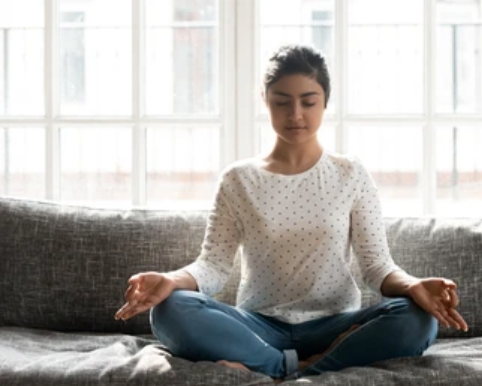
Breath focus in practice. Once you've taken the steps above, you can move on to regular practice of breath focus. As you sit comfortably with your eyes closed, blend your breathing with helpful imagery and a focus word or phrase that will help you relax. Imagine that the air you breathe in washes peace and calm into your body. As you breathe out, imagine that the air leaving your body carries tension and anxiety away with it. As you inhale, try saying this phrase to yourself: "Breathing in peace and calm." And as you exhale, say: "Breathing out tension and anxiety." When you first start, 10 minutes of breath focus is a reasonable goal. Gradually add time until your sessions are about 15 to 20 minutes long.
Harvard Mental Health Letter